

BEFORE ABRAHAM WAS, I AM: A SYNTHESIS OF EXISTENTIALISM, BIOLOGY, AND ESOTERIC METAPHYSICS
I. The Philosophical Battleground: Essence vs. Existence
For centuries, Western philosophy operated under the classical assumption that essence precedes existence. This view holds that the nature, purpose, or “blueprint” of a thing is fixed before it ever physically exists.
Classical View (Essentialism): Blueprint (Essence) ──► Physical Reality (Existence)
Sartre’s View (Existentialism): Physical Reality (Existence) ──► Blueprint (Essence)
- Aristotelian Metaphysics: A knife is designed for cutting; its purpose is determined before the blade is forged.
- Scholastic/Christian Philosophy: Human beings are created according to a divine plan, born with an inherent nature and destiny.
In the 20th century, Jean-Paul Sartre inverted this paradigm with his foundational maxim: “Existence precedes essence.” Sartre argued that humans are not born with a built-in purpose. Instead, we are thrown into the world without a predefined identity. We exist first, encounter ourselves in the world, and only afterwards define who we are through our choices and actions.
Because no divine script or biological blueprint determines our moral destiny, Sartre claimed we are “condemned to be free.” This absolute freedom strips away all excuses, leaving us with:
- Responsibility: We are the sole authors of our values and character.
- Anguish: The weight of knowing we cannot blame God, biology, or fate for our failures.
- Bad Faith (Mauvaise foi): The psychological escape mechanism where we hide behind societal roles or excuses to evade our radical freedom.
While acknowledging that our bodies, history, and cultures condition our choices, Sartre maintained they do not determine them. Purpose is authored, not discovered.
The Botanical Parallel
Even in modern botany, this tension plays out. Scientists use Functional-Structural Plant Models (FSPM) to predict plant development. While an individual plant’s DNA looks like a predetermined blueprint (essence), its evolutionary history reveals that this genetic code is actually a historical record forged by millions of years of physical adaptation (existence). Furthermore, plants display immense developmental plasticity. A tree’s final shape is not rigidly locked in its seed; it changes its wood density in response to the wind and reroutes its roots when it hits a rock. It is a dynamic process—an ongoing interaction between genetic potential and environmental existence.
II. Existence and Biology: The Myth of the Random Lottery
From the cosmic scale of consciousness down to the microscopic architecture of gametes, creation is driven by a rigorous, multi-layered process of selective affinity. Attraction and conception are never blind lotteries; they are sophisticated dialogues of mutual choice and rejection.
1. The Sweaty T-Shirt Study (Macro-Selection)
In 1995, Swiss zoologist Claus Wedekind conducted the famous “Sweaty T-Shirt” experiment. Women smelled plain cotton shirts worn by men for two nights and rated their attractiveness. DNA mapping revealed that women overwhelmingly preferred the scent of men whose Major Histocompatibility Complex (MHC) genes were radically different from their own.
- The Evolutionary Mechanic: The MHC gene family dictates the immune system’s parameters. If you mate with a genetic mirror, your offspring inherit a narrow shield against disease. If you mate with someone possessing a complementary, diverse MHC profile, your offspring receive a vastly broader biological shield.
- Statistical Advantage over Destiny: This invisible matchmaking isn’t a pre-programmed cosmic romance. It is natural selection operating over millions of years. Ancestors possessing this olfactory radar raised healthier children, while those lacking it saw their genetic lineages fade away.
2. Cryptic Female Choice (Micro-Selection)
For decades, traditional biology taught a hyper-competitive fable: millions of active sperm race mindlessly toward a passive, waiting egg. Landmark 2020 studies by John Fitzpatrick (Stockholm University and University of Manchester) shattered this narrative, proving that reproduction is a highly selective cellular conversation.
The human egg actively secretes chemical signals called chemoattractants in its follicular fluid to guide, root for, and select specific sperm—a phenomenon known as cryptic female choice.
| Selection Factor | Microscopic Mechanism | Biological Goal |
| MHC Complementarity | Fluid preferentially attracts sperm with radically different immune genes. | Maximizes genetic diversity and offspring pathogen resistance. |
| Quality Control | Fluid turns down the “chemical volume” for sperm with overly similar genetic profiles. | Prevents genetic dead-ends and dangerous homozygous mutations. |
The egg evaluates incoming genetic fragments and dynamically tilts the scales. You are not simply the winner of a blind race; you are the product of a rigorous maternal vetting process.
III. Existence and Karmic Affinity
This biological selectivity finds an extraordinary echo in metaphysics. The Bardo Thodol (The Tibetan Book of the Dead) posits that rebirth is not a random drop into an open womb, but a process governed by psychological resonance and karmic affinity.
According to the text, a wandering consciousness is drawn to its future parents by intense forces of attraction and aversion. If it experiences attraction toward the father and aversion toward the mother, it incarnates with a female body; if the reverse occurs, it takes a male body.
Historical Note: When Carl Jung encountered this text, he noted its striking similarity to Sigmund Freud’s Oedipus complex, inspiring the concept of the Electra complex to describe a daughter’s subconscious psychological alignment with her father. At both the cellular and metaphysical levels, incarnation demands a precise energetic match. The soul selects its entry point based on its unresolved desires and attachments.
IV. The Great Metaphysical Challenge: The Universe as a Machine
When we weave these threads together—ancient Tibetan metaphysics, evolutionary biology, and cellular microbiology—a unsettling realization emerges: all things operate like beautifully calibrated machines, entirely empty of a permanent, independent essence.
In Buddhism, this absence of an inherent, separate self is called Anatta (No-Self) or Sunyata (Emptiness). If everything is merely an evolutionary or mechanical program, the concept of a fixed “self-nature” dissolves in three ways:
- Dependence Over Independence: A mechanical clock cannot tick-tock on its own; it requires gears, springs, and a craftsman. Similarly, a tree possesses no standalone “tree-ness.” It is an ephemeral transaction between DNA, sunlight, soil, and wind. Strip away the environment and evolutionary history, and no core “tree” remains.
- The Illusion of the Whole: “The clock” is just a convenient label for an assembly of brass parts. Likewise, the egg choosing a sperm is not a singular, unified “self” making a conscious decision. It is the emergent property of millions of mindless biological gears—calcium channels, receptors, and genes—firing in unison.
- Constant Flux vs. Fixed Essence: A system that constantly adapts cannot have a static essence. A tree alters its wood density; a woman’s biological odor preferences shift if she takes birth control pills; a wandering soul’s gender alters based on its glance in the Bardo. These systems are verbs, not nouns. They are ongoing processes, not static objects.
Materialism vs. Interdependence
Science and Buddhism look at this essenceless “clockwork” universe and derive two entirely different emotional frequencies:
- Scientific Materialism (Determinism): Views this reality as cold and robotic. We are biological puppets pulled by the invisible, deterministic strings of DNA and physical laws.
- Buddhist Philosophy (Interdependence): Views this reality as profoundly liberating. Because you lack a fixed, rigid “self-nature,” you are not trapped in a permanent mold. You are a fluid part of a massive, flowing web of cause and effect.
The Failure of Traditional Systems
This absolute essencelessness poses an existential threat to classical thought:
- Theology: If nothing has a permanent essence, who is the sinner, and who needs a savior?
- Philosophy: It dismantles Plato’s perfect forms, Aristotle’s unmoved mover, Aquinas’s first cause, Kant’s pure reason, Hegel’s Geist, and even Sartre’s radical free choice (by reducing choices to biochemical algorithms).
- Neoplatonism: If Plotinus claims all things return to “the One,” he must explain how an entity overcomes the ruthless mechanical forces of genetic selection, and what motivates a machine to return to the source.
- Gurdjieff’s Paradox: Gurdjieff famously argued that ordinary men are unconscious machines reacting blindly to external impressions and planetary shifts. However, he introduced a contradiction: he claimed that if a man realizes he is a machine, he can “change the internal arrangement” and cease being a machine. But if a man possesses zero initial consciousness or free will, what capacity within him performs the rearranging?
V. The New Metaphysics: The Law of Three and the Divine Play
Traditional systems fail because they rarely investigate the source of the forces that deny things a static essence. What is the power directing the egg’s choice or the woman’s olfactory preferences?
It is the Law of Three at play—an esoteric framework composed of three primary forces:
- The Creative / Affirming Force: Drives a seed to sprout, a tree to grow a new branch, or a woman to prefer a man with a complementary MHC gene to generate resilient life.
- The Destructive / Denying Force: Prompts the egg to reject incompatible sperm or a woman to find the scent of a similar MHC profile unappealing.
- The Neutralizing / Balancing Force: Shifts a woman’s preferences toward similar MHC profiles during pregnancy or when taking birth control pills, intuitively guiding her to seek the comfort, support, and protection of kin.
This dynamic reality implies a profound unity between two dimensions of existence:
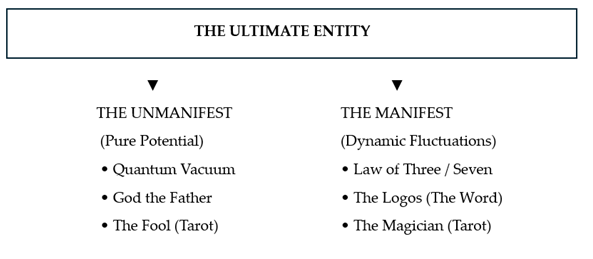
The Sweaty T-Shirt study, cryptic female choice, botanical plasticity, and the Bardo Thodol all validate the idea that nothing has a fixed, independent essence. Yet, the omnipresence of the Law of Three proves that an Ultimate Reality pulses at the heart of all fluctuations.
From Emptiness to Lila
Rather than framing this ultimate entity through the negative, clinical lens of Sunyata (Emptiness), it is far richer to employ the Hindu concept of Lila—Divine Play.
Brahman, the ultimate reality, overflows with unadulterated joy. Through OM, the soundless sound, he cosmicly projects himself into all things. Each incarnation is simply Brahman wearing a different mask to participate in a grand, cosmic play. The design of the game requires each actor to play their part so intensely, so passionately, that the mask eventually cracks. In that moment of awakening, the individual realizes they were never just the actor; they are Brahman himself.
- In Advaita Vedanta, the individual Atman is merely Brahman wearing a temporary mask.
- In the Gospel of John, Abraham is the eternal consciousness wearing a historical mask.
When Jesus declares, “Before Abraham was, I Am” (John 8:58), he isn’t claiming chronological seniority; he is piercing the veil of the machine. He is announcing that beneath the shifting biological gears, the genetic selections, and the karmic masks of existence, resides the singular, unmanifest, timeless Reality.
(End)
