

- 3 – THE RETURN OF ALL THINGS
- 3.1 – LEFT BRAIN: LOGIC
- 3.2 – RIGHT BRAIN – INTUITIVE
- 3.3 – 1ST OBSTACLE: ADRENAL GLAND
- 3.4 – 2ND OBSTACLE: PINEAL GLAND
- 3.5 – 7 STEPS AND 5 SEGMENTS
3 – THE RETURN OF ALL THINGS
Humans uniquely possess both a mind and a brain, enabling them to recognize and respond to stimuli from the Sun, Earth, and Moon through society, family, school, and their inner thoughts. Crucially, they can also resist the influences of these forces and seek personal liberation. This journey, marked by challenges symbolized by Mi-Fa and Si-Do, is uniquely human. Thus, understanding brain structure is vital.
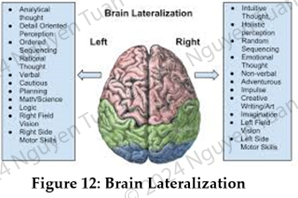
In 1960, Roger Sperry discovered that the brain’s left hemisphere controls the right side of the body, while the right hemisphere governs the left. The left brain is associated with logic, language, and order, whereas the right brain is linked to creativity, intuition, and emotions. See Figure 12.
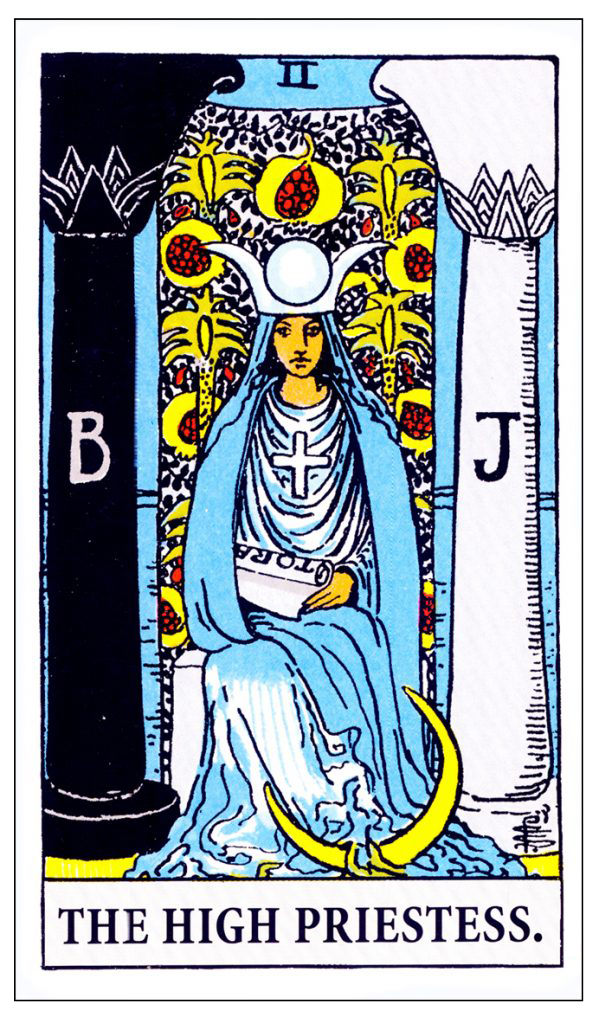
In the Tarot’s High Priestess card, the black pillar represents the right brain, while the white pillar symbolizes the left brain. At the card’s center sits The High Priestess, her gown mirroring the blue sky behind the veil. The hidden message suggests that direct access to the transcendental realm, represented by the blue sky, is not possible; one must delve deep into their innermost self to penetrate the veil of thought and emotion. The High Priestess’s diadem features three phases of the Moon and a missing Moon, signifying her understanding of both life and death. At her feet lies a crescent moon, which symbolizes death; when Osiris died, his body was placed in a coffin shaped like a crescent moon, indicating her conquest over death.
The yellow river between the High Priestess and the two pillars symbolizes the boundary between samsara representing by the 2 pillars, and nirvana which is the High Priestess. Thus, the black pillar, the symbol of right brain, or intuition, the white pillar symbolizing left brain or logic, and the High Priestess symbolizing pure energy reflect the Law of the Three of the human psyche.
3.1 – LEFT BRAIN: LOGIC
According to brain structure, left-brain leads to science and philosophy. Science has confessed that the universe is just a shadow of a hidden entity that science cannot know; and although science makes life beautiful, it cannot help you live a meaningful life. Philosophically, Sartre felt nausea everywhere. And according to Camus, the only important philosophical problem is suicide. In terms of neuroscience, Dr. Iain McGilchrist, arguably the world’s greatest authority, asserts that almost everything you think about the brain is wrong. Some examples related to the operation of the left brain:
1. Left brain depends heavily on logic, even if its logic may be wrong, it will find ways to hide or ignore these errors;
2. Left brain processes information individually and in isolation, ignoring the larger reality. In this way, it creates a virtual and mechanical world;
3. Left brain focuses on single solutions that fit what it already knows and sticks to it. Anything that goes against its old bias is rejected;
4. Left brain is prone to extremism: once it has a bias, it resists any change that goes against its views. Unusual things are ignored, or ignored;
5. Left brain is dictatorial in thought and action, abhorring uncertainty;
6. Left brain relies on limited information and quickly jumps to conclusions, considers them true, and then insists that the conclusions are correct.
3.2 – RIGHT BRAIN – INTUITIVE
So, the only possible way is to follow the emotions of the right brain to find the innocent childhood, when you lived intuitively. Many studies show that from birth to about five years old, all children are geniuses. Around 7-8 years old, only about 15% remain, and by about 30, only about 2%. Many earth shatting inventions that changed human history are based on intuition; reason is only a later stage, used to explain to others, or to establish theories. Recent studies show that when the right brain is active, the sense of space and time disappears along with the ego and the universe.
3.3 – 1ST OBSTACLE: ADRENAL GLAND
Hence, thinking, associated with the left brain, is linked to death, while emotion, the realm of the right brain, represents life. Nonetheless, humans possess both thinking and emotion, which create two significant obstacles. The first obstacle involves three basic needs: food, sex, and power, which are intertwined with survival. The adrenal glands play a crucial role here by secreting adrenaline, provoking a fight-or-flight response in life-threatening situations (Figure 13).

Additionally, jealousy, driven by the fear of losing something valuable, arises as a protective instinct—both emotions prompt a rush of adrenaline that ensures survival. Overall, the adrenal glands fuel greed, anger, and ignorance, marking the first challenge to overcome in shifting from the left brain to the right brain or moving toward spirituality. This transition proves difficult due to societal pressures to achieve financial success, secure a beautiful partner, and attain a high social standing.
However, a window of opportunity opens for men aged 28-34: research by British psychologists indicates that this age group tends to feel a strong urge for change. For many, this urge fades, but if a great soul emerges during this period, some courageous individuals may respond, overcoming their obstacles with his guidance.
3.4 – 2ND OBSTACLE: PINEAL GLAND
After overcoming this obstacle, a period of self-cultivation and virtue accumulation leads to the final challenge between delusion and illumination. At this stage, life’s temptations no longer attract you, yet thoughts and emotions persist, indicating that our understanding remains flawed; these thoughts and emotions act as a veil obscuring the true world. This veil affects the pineal gland, located at the intersection of the left and right brains (Figure 14).

In a 1962 experiment at Boston University, psychologists Leary and Alpert divided students into two groups. The placebo group reported no significant experiences, while the psilocybin group had profound encounters, with some exclaiming, “I am God!” or “Oh Holy!” Notably, scholar Houston Smith, part of the psilocybin group, described it as “the greatest return” he had ever experienced.
This experiment and reports from near-death experiences indicate that when the senses are subdued, the pineal gland opens, offering a glimpse of the true world, though thoughts and emotions remain. The veil created by these thoughts and emotions is difficult to penetrate, as enlightenment is an unnatural phenomenon. Thus, it requires a great soul to create the conditions for this phenomenon to occur by halting sensory perception while remaining fully awake. In that moment, thoughts and emotions vanish, revealing what was previously hidden. This is liberation—freedom from thoughts and emotions, and liberation from samsara.
An important fact about the pineal gland is its role in the transition to the afterlife. It is situated between the two hemispheres of the brain, and at death, the soul exits the body through the pineal gland. When individuals die suddenly, they often cannot close their eyes due to the lack of time, and the soul must follow the pineal gland out. In contrast, when a saint meditates, the body may die while the individual remains fully conscious.
3.5 – 7 STEPS AND 5 SEGMENTS

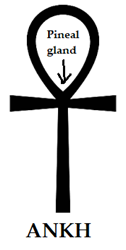
Thus, the return journey is divided into five sections. The first section includes three parts: eating and drinking, lust, and power. The second section marks the boundary between spirituality and society, located at the adrenal gland. The third section lies between the adrenal gland and the pineal gland. The fourth section represents the boundary between delusion and enlightenment, situated at the pineal gland. The fifth section, beyond the pineal gland, leads to the realm of suchness, the absolute. This five-section path, with obstacles in the second and fourth sections, resembles an octave and is illustrated in the Weighing of the Dead’s Heart ceremony (Figure 15). In the image, the god Thoth on the right represents the left brain, while the goddess Maat on the left symbolizes the right brain. To Maat’s left is the soul of the deceased being guided to reincarnation by the dog-headed god Anubis, as the deceased’s heart (on the right) is heavier than the feather, which represents a life free of desire, needs, and thoughts. Maat’s left hand holds the key to life, the ANKH, symbolizing the pineal gland (Figure 14). Therefore, the key is to follow the right brain (Maat’s left hand) into the inner self and then transcend the pineal gland into the realm of suchness, bliss, and liberation. The knobs on the scale signify the following meanings:
Knob 1 represents the need for food, 2 signifies lust, 3 stands for power, and the animal’s beak symbolizes the adrenal gland. Knob 4 finds balance in life; 5 denotes compassion arising from a balanced mind; 6 offers a glimpse into the transcendent world; and 7 encourages solitude to realize that glimpse. The balance beam represents the pineal gland, where, despite having a glimpse, thoughts and emotions persist, indicating the left and right brains remain active. The knob above the balance beam leads to the transcendent world, accessible when the meditator is fully awake while the body undergoes death, resulting in a paralyzed brain and temporarily halted senses, erasing thoughts and feelings.
This defines liberation as freedom from thoughts and emotions, while enlightenment signifies absolute awareness during the body’s death. The Egyptians recognized this secret thousands of years ago in the myth of the Eye of Horus, now corroborated by recent neurological findings (Figure 16).

The Eye of Horus includes: Nose (1/2), Eyes (1/4), Mind (1/8), Ears (1/16), Tongue (1/32), and Hands (1/64), encompassing both the concrete (five senses) and abstract (mind) realms. The sum of these components totals 63/64.
1/2+ 1/4+ 1/8+ 1/16+ 1/32+1/64= (32+16+8+4+2+1)/64= 63/64.
The pineal gland, an organ absent from the Eye of Horus, perceives what is neither concrete nor abstract. It activates only when the Eye of Horus is closed—essentially, when the body dies while the mind remains fully aware. In this state of consciousness during death, one can grasp truths beyond the senses and the intellect. That is truth; that is life.
