

- 4 – EGYPTIAN I-CHING
- 4.1 – BRAIN STRUCTURE
- 4.2 – LAW OF THE THREE
- 4.3 – LAW OF THE SEVEN
- 4.4 – 64 HEXAGRAMS OR GUA
- 4.5 – 8 TRIGRAMS – BAGUA
- 4.6 – I-CHING AND ENLIGHTENMENT
- 4.6.1 – DRAGON STILL HIDDEN
- 4.6.2 – DRAGON IN THE FIELD
- 4.6.3 – DRAGON IN THE SKY
- 4.6.4 – DRAGON FLIES TOO HIGH
- 4.6.5 – HEADLESS DRAGONS
- CONCLUSION
4 – EGYPTIAN I-CHING
Egyptian I-Ching. The ancient Egyptians recognized the cycle of departure and return from a common source, a concept overlooked by Eastern sages such as Fu Xi, King Wen, Duke of Zhou, Confucius, Shao Yong, Zhu Xi, etc. Consequently, for thousands of years, Far Eastern intellectuals have focused on the I-Ching as a divination tool, failing to realize it is one of humanity’s most profound scriptures. This includes aspects such as the brain, the Laws of Three and Seven, the ray of creation, the adrenal gland, and the pineal gland.
4.1 – BRAIN STRUCTURE
The hexagram 63, Line 5 states, “While the eastern neighbor slaughters a buffalo to celebrate, the western neighbor makes a simple offering but is truly blessed.” The East represents the left brain, associated with logic, reasoning, and the realms of philosophy, science, and technology. Slaughtering a buffalo symbolizes a grand celebration and abundance. The West corresponds to the right brain, which encourages introspection and leads away from fame and power. It promotes a journey into the inner self, guided by the pineal gland, transcending sensory constraints, thought, and emotions to realize immortality and the essence of being truly blessed.
4.2 – LAW OF THE THREE
Law of the Three is the trio that creates all living things on Earth. Instead of Sun, Earth, Moon, China calls it Heaven, Man, Earth. That is a fatal mistake. As discussed above, without the Moon, life on earth is impossible. As a result, China does not know how life pans out (Figure 11), nor does it know the way back, and the two obstacles caused by the adrenal gland and pineal gland (Figure 15).


4.3 – LAW OF THE SEVEN
This law is hidden in the hexagrams 24, Fu, and hexagram 18, Gu (decay, desruption, corruption, deviation, etc). The Decision of the Fu hexagram says, “Returning is the Dao. 7 days return.” The Chinese explains that from the Gou hexagram 44, is the 5th month, to the Fu hexagram, the 11th month, is 7 months. From 5 to 11 is only 6, but it is said to be 7!
So, what does “Return in 7 days” mean? The seven days return is an octave. From the Do of this octave to the Do of the next octave is 7 – Do-Re-Mi-Fa-Sol-La-Si-Do. In these 7 segments there are two deviations between Mi-Fa and Si-Do. The Decision from the Gu hexagram 18 says, “3 days before, 3 days after”. Chinese explains “3 days before Jia is Xin – Xin, Ren, Gui, Jia. And after “3 days after Jia” is Ding – Jia, Yi, Bing, Ding. This time from Jia to Ding is 3, not 4, as from 5 to 11 in the Fu hexagram.
This is a fallacy! If each day is attached to a heavenly stem, it means 10 days return – from Jia to Jia is 10-day return, which runs counter to the 7- day return of the Fu hexagram.

So, what is “3 days earlier, and 3 days later”? The new cycle starts at Do, when it reaches Re, Mi, it deviates at Fa. And before Fa 3 days – Mi, Re, Do, there has been a deviation at Si-Do of the previous octave. And after Fa 3 days – Sol, La, Si, there will be another deviation at Si-Do. So, in an octave there are two deviations at Mi-Fa and Si-Do, that is, each octave has 4 segments: Do-Re-Mi; Mi-Fa; Fa-Sol-La-Si; and Si-Do. See Table 1. Thus, the Law of the Three, and the Law of the Seven are hidden in the hexagram 24 and hexagram 18, which is a proof that the I-Ching has a non-China origin.
4.4 – 64 HEXAGRAMS OR GUA
Figure 4 contains three octaves, each divided into four segments as detailed in Table 1. The octaves are designated as follows: Dao-Sun = Sun, Sun-Earth = Earth, and Earth-Moon = Moon. The segments of each octave are known as the Four Symbols: Old Yin, Young Yin, Young Yang, and Old Yang. refer to Table 1, column 4. Figure 4 is graphically represented by Figure 17, where the three horizontal bars stand for the Sun, Earth, and Moon, respectively, and the four tails below represent Old Yin, Young Yin, Young Yang, and Old Yang. This pictogram represents the I-Ching, which has often been misunderstood by scholars as the term “I-Ching.”


When combining the Four Symbols of the Sun octave with those of the Earth octave, a total of 16 elements is generated, each consisting of four lines that can be either solid or broken. Combining these 16 elements with the Four Symbols of the Moon octave yields 64 hexagrams. Thus, 64 is derived from the formula 4x4x4. See Figure 18, which also applies to the construction of 64 DNA codons. This formula explains the division of lines: 1-2 for the Moon, 3-4 for Earth, and 5-6 for Sun. This structure differs from the Chinese trigram method, which derives 64=8×8 and fails to clarify the grouping of hexagram lines: lines 1-2 belong to Earth, 3-4 to Man, and 5-6 to Sun.
4.5 – 8 TRIGRAMS – BAGUA
Having established 64 hexagrams, Descartes’ method can be employed to simplify this complex scenario. By halving the 64 hexagrams, you obtain eight single trigrams, known as Bagua. The Bagua comprises two orders: the Pre-Heaven Bagua consists of four symmetrical forces present across time, defined by pairs of opposites: Qian-Kun, Dui-Gen, Li-Kan, and Zhen-Xun. See Figure 19. The Post-Heaven Bagua represents a dialectical process from beginning to end, progressing from Zhen to Gen: Zhen-Xun-Li-Kun-Dui-Qian-Kan-Gen See Figure 20.


4.6 – I-CHING AND ENLIGHTENMENT
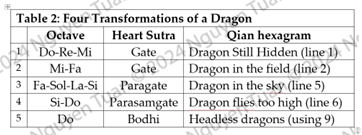
The Decision of the Fu hexagram states, “Return is the Dao. In seven days comes the return.” A 7-day return represents an octave, which contains two deviations between Mi-Fa and Si-Do, according to hexagram Fu 24, and Gu 18. This transforms the octave into a 4-segment path with obstacles at segments two and three. Overcoming these obstacles requires assistance from a great soul. In the I-Ching, this 4-segment path with its two obstacles is illustrated by the 4 transformations of a dragon in the Qian hexagram, or four gate of the Heart Sutra’s great mantra, see Table 2.
4.6.1 – DRAGON STILL HIDDEN
Do-Re-Mi: Qian, line 1 states, The Dragon Is Still Hidden. Hexagram 5 Xu, line 6 states, “Three guests come slowly.” These guests symbolize food at Do, sexual desire at Re, and power at Mi. Why Slowly? Infants immediately crave for food; desire manifests around ages 13-14, and the quest for power begins after 20. This reflects the biological needs that must be met before spiritual aspirations arise. Those who pursue monastic life before… fulfilling these needs often do so for economic or psychological rather than spiritual reasons.
4.6.2 – DRAGON IN THE FIELD
Mi-Fa: Qian, line 2 states the Dragon in the field, meeting a great person is beneficial. Psychologically, men aged 28-34 typically experience a quarter-life crisis, fueling a desire to overcome the adrenal gland (first obstacle). While most will outgrow this feeling, some are compelled to seek something undefined meaning Dragon in the field. If you are fortunate enough to encounter a holy individual during this time, you may receive guidance toward a spiritual path, that is, meeting a great person is beneficial. For instance, Sariputra and Maudgalyayana were inspired by Aśvajit’s verse to pursue religion. Angulimala found refuge in the Buddha, and Valmiki turned to spirituality through Naropa. Many of Jesus’ disciples, while fishing, left everything to follow Him when He said, “Follow me to fish for people.” Thus, Mi-Fa marks the boundary between the secular and the spiritual. Failing to cross this boundary may result in endless cycles of samsara and suffering unless you can overcome the two obstacles.
4.6.3 – DRAGON IN THE SKY
Fa-Sol-La-Si: Dragon In The Sky. Qian line 5 states, the dragon is in the sky, meeting a wise person is highly beneficial. After a long period of self-cultivation and virtue accumulation, you stand at the threshold of delusion and enlightenment. That is the meaning of the dragon in the sky. At this stage, thoughts and emotions persist, and you cannot eliminate them on your own. If you are fortunate enough to encounter a sage, he can facilitate a union of your brain hemispheres, allowing those thoughts and emotions to dissolve. This leads to liberation and an understanding of your true nature; hence, meeting a great person is beneficial. However, if you cannot release your thoughts and emotions, you will continue to experience reincarnation until you manage to close the Eye of Horus. Thus, rebirth occurs at two points: the adrenal gland and the pineal gland.
4.6.4 – DRAGON FLIES TOO HIGH
Si-Do: Qian line 6 states, the dragon soars too high, there is something to regret. Enlightenment or liberation is inherently unnatural, as our minds constantly fluctuate between thoughts and emotions, which cannot be directly eliminated. Thus, one must depend on a saint to facilitate this unnatural transformation. A common method is to induce a shock that unites the two hemispheres of the brain. Jesus, in the Gospel of Thomas, states, “Make the two become one… you will enter the Kingdom of God.” This unity involves freeing the left brain from thoughts and the right brain from emotions. In the Heart Sutra, Avalokiteshvara enlightens Sariputra by discarding all Buddhist teachings: such as the Four Noble Truths and the twelve links of dependent origination, etc.
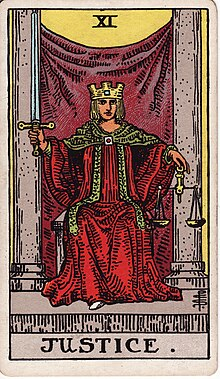
In the Tarot, the Justice card portrays a master with a double-edged sword, signifying an awakening shock that suspends thought processes. The balance scale represents the cessation of thoughts and emotions, reflecting the merging of the two brain hemispheres. The two grey pillars behind the master symbolize the disappearance of of thoughts and feelings. Jesus’ method is particularly unique; rather than enlightening individuals, He captured the entire crowd’s attention through His crucifixion. As He was being crucified, the crowd was transfixed in horror, their breathing halted and thoughts silenced, experiencing a profound moment of awareness.
But why regret? When thoughts and emotions vanish, the body dies in that heightened awareness, and the ego fades; even the desire to share experiences is rendered useless without a physical form. The body’s death coincides with the opening of the pineal gland, ushering one into a realm of truth and bliss. After attaining enlightenment, Buddha remained silent for a week, unable to articulate his experience. When Pilate asked Jesus, “What is truth?” He stayed silent. Similarly, when someone asked Osho, “What is innocence?” he paused for a moment before ending the talk.
4.6.5 – HEADLESS DRAGONS
Do: Qian using 9 states, “Seeing headless dragons. Good fortune.” The head symbolizes the brain’s dual roles of thinking and feeling, which foster a false sense of ego. Upon the pineal gland’s awakening, the body temporarily dies, and the ego disappears along with thoughts and feelings. This liberation signifies enlightenment—the realization of one’s origin and subsequent return.
It is extremely critical to note here. Unlike other lines in a gua which is either solid or broken, “Using 9” is neither because it lies outside the purview of Law of the Three, and Law of the Seven which are laws of the visible world. Outside Law of the Three, and Law of the Seven meaning enlightenment is an event outside of space and time. That is the realm of truth, and other than the Dao, there is nothing at all.
CONCLUSION
The I-Ching is an ancient source of esoteric knowledge, but for many milleniums it has been used for as a tool for divination. Recent scientific discoveries have assisted in decoding its writings, revealing truths about the universe and human nature. Unlike modern religions, the I-Ching has no dogmas and can be empirically validated without requiring worship or rituals. The main challenge involves overcoming issues related to the adrenal and pineal glands, often neglected by modern religions. Guidance from a realized teacher is crucial unless you possess exceptional wisdom like Buddha or Jesus. Ultimately, the I-Ching encourages you to embrace life; true contentment renders fame and power irrelevant, revealing your inner peace.
The I-Ching embodies a spirituality free from religious constraints, offering profound insights arising from a divine plan. A good example is that a large collection of Gnostic Gospels was accidentally discovered in Egypt in 1945. In the case of I-Ching, early 20th-century magi George Gurdjieff introduced concepts like Ray of Creation, Law of the Three and the Seven. Then the 1950s DNA discovery linked together Gurdjieff’s teaching, the universe, living cells, the I-Ching, Tarot, and astrology. The 1960s saw brain lateralization research by Roger Sperry, followed by Functional magnetic resonance imaging (fMRI) developments in the 1980s, allowing brain activity observation. Furthermore, Google enables easy access to documents worldwide that connect scientific discoveries with the I-Ching, Tarot, Gnostic teachings to name a few.
Essential lessons from the I-Ching assert that you are the master of the universe; seek no external salvation and nurture your inner self (hexagram 5, line 6). If your needs are unmet, inner conflict arises, leading to the search for external enemies, which explains the prevalence of war. Lacking inner peace and happiness compels you to seek fulfillment outside, resulting in endless wars and destruction, often attributed to religion’s influence.
(End)
