

NEO-GNOSTIC CHRISTIANITY
- OVERVIEW
- THEOLOGICAL CONTEXT
- MACRO-HOLOGRAPHIC UNIVERSE
- LAW OF THE THREE
- LAW OF THE SEVEN
- RAY OF CREATION
- MICRO-HOLOGRAPHIC UNIVERSE
- TREE OF LIFE
- NEO-GNOSTIC CHRISTIANITY AND THE WORD
- CONCLUSION
OVERVIEW
“And you will know the truth, and the truth will set you free.” (John 8:32).
The Gospel of John is vital to Christianity; it is foundational to the faith. This video explores Chapter 1, focusing on key theological themes, particularly the mystery of The Word, the second Person of God, who became human, died for our sins, and offered eternal life to believers. However, several important issues are often overlooked:
1 – While Genesis and the Nicene creed claimed the God the Father created the world, according to John, it was the Word who created the world, not God;
2 – There are two “the Word,” one in John 1:3 and John 1:14;
3 – The Word of John 1:3 is the creator, whereas the The Word of John 1:14, understood to be Jesus, is the created who “was made flesh” by the Word of John 1:3.
These issues appear to have remained unaddressed. Thus, I wish to propose the following interpretations of John’s view on the Word:
1. God is the ultimate and sole existing entity, rendering creation unnecessary for Him.
2. The Word serves as God’s creative principle, through which He incarnates in all things, including Jesus. 3. Consequently, the universe is merely varied manifestations of God.
THEOLOGICAL CONTEXT
Biblical historians consider Mark the first gospel, written around 70 AD, followed by Matthew and Luke around 80, and John around 95. Although titled “Gospel According to Matthew…,” all four Gospels are attributed to anonymous authors, leaving historians to speculate on their identities (Powell). Prior to Mark’s writing, Pauline epistles circulated in Eastern Roman Christian communities, leading to the exclusion of texts inconsistent with Pauline theology, such as the Gospels of Thomas and Judas. This raises questions about which Paul founded Christianity, though academically it is a minor issue—there are multiple Pauls and no singular Christianity. After establishing Christianity as the state religion, Emperor Constantine convened the Nicene Council in 325 to unify Christian factions and create centralized leadership under the Pope.
Paul’s group argues that humanity fell into sin when their ancestors ate the forbidden fruit, resulting in death and the necessity for a savior to mediate between God and humanity. This belief is grounded in the Gospel of John. Paul’s account of his divine encounter on the road to Damascus links him to Jesus; however, some scholars question the event’s authenticity. Acts 23:6-10 indicates Paul identified as a Pharisee who believed in the resurrection, not as a Christian.

The Gospel of John suggests Christianity is rooted in Judaism, stating that The Word created all, contradicting Genesis and challenging the Nicene Creed. While the creed asserts the resurrection of the dead, this belief is missing from the four Gospels and the Gnostic texts banned by Catholicism. Christianity, through its branches, has a history of violence, including genocides and persecutions, as noted in both the Old Testament and throughout the last 2000 years in the Global North. This legacy continues today, reflected in Israel’s actions against Palestine.
An important yet often overlooked aspect of John 1 is the dual role of “The Word.” Verse 3 states that all things were created through The Word, while verse 14 notes that The Word “was made flesh.” Here, “The Word” as the creator is distinct from God the Father, while in verse 14, The Word (Jesus) embodies the creative power. This highlights the roles of “The Word” as creator and incarnate. Saint John adeptly used language to challenge leaders and promote his Gospel. Understanding “The Word” is crucial for grasping John 1’s profound message.
Another document related to “The Word” was excluded from the New Testament by Catholicism. After the Last Supper, the Gospels mention Jesus and His disciples sang together before His arrest. The Acts of John, excluded from the New Tastement, however, contains the full song:
After the Last Supper, in the garden, Jesus invited His disciples, “Sing with me!” They formed a circle around Him.
He began to dance and sing, “Glory to the Father!” The disciples responded, “Amen.”
Then Jesus sang, “Glory to The Word!” – “Amen.” “I will be born and I will suffer!” – “Amen.”
“I will eat and I will be eaten!” – “Amen.”
Jesus proclaimed, “Those who dance and sing with Me, follow My example, for the love of humanity I will suffer!” – “Amen.”
“I will flee and I will stay!” – “Amen.” Jesus sang, “I will be united and I will be united!” – “Amen.”
“I am the door at which you have knocked… I am a path for you, a traveler.”
When the song concluded, Jesus went out to be arrested and crucified.
In the context of this song, Jesus is not “The Word.” He stated: 1 – “I will be born and I will suffer,” indicating that He was born through The Word. 2 – “I will flee and I will stay,” expressing his dual nature as both a criminal who runs and an honest person who remains. 3 – “I will eat and I will be eaten,” likening Himself to a deer or buffalo, feeding on grass while being preyed upon by tigers and lions. Everything is “I,” with the universe as its different forms. This connects to the holographic universe theory, seen by science as speculation. Science suggests that the universe is a shadow of a hidden entity it cannot fully grasp. In Buddhism, this is Emptiness, while in Hinduism, it’s Brahman. However, these beliefs don’t explain how this entity interacts with the universe, leading to chaos without governing rules. Neo-Gnostic Christianity identifies this ultimate entity as God, with The Word as His creative principle.
MACRO-HOLOGRAPHIC UNIVERSE
The universe can be seen from macro and micro perspectives. At the macro level, celestial hierachies resemble each other, while at the micro level, the smallest units reflect the largest structures. The macroscopic holographic structure of the universe is organized into galaxies, which contain suns, hosting planets and possibly moons. This organization is based on two Neo-Gnostic Christian laws: the Law of Three, representing forces of change, and the Law of Seven, ensuring order. These laws illustrate God’s creative principles, known as “The Word.” God does not will creation; instead, the universe emerges from The Word. In void, God and The Word are unified, but as conditions change, The Word manifests new phenomena, like a tree sprouting from a seed in fertile soil. Similarly, when galaxies reach a specific distance apart, The Word facilitates galaxy formation. Ultimately, all creation arises from The Word, which signifies God’s presence in the universe. In this context, the God of Neo-Gnostic Christianity differs from Judeo-Christianity, as The Word incorporates both the Law of Three and the Law of Seven.
LAW OF THE THREE
Law of the Three refers to the three forces that initiate all changes in the universe. This video provides a brief overview of the concept. These forces are described in various terms:
1. Active, reactive, neutral; 2. Creation, nourishment, destruction; 3. Gravity, attraction, repulsion; 4. DNA: base 1, base 2, base 3; 5. Astrology: cardinal, fixed, mutable; 6. I Ching: Heaven, Earth, Moon; 7. Physics: Gravity, strong force, weak force.

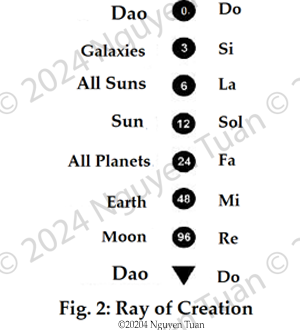
A key principle of the Law of Three is that at each intersection of these forces with space and time, a new creation unit and three new forces emerge. Therefore, the total force of any unit equals the forces from the units above it plus three new ones. For example, as shown in Fig. 2, the sun’s total force is 12, derived from 0 of God + 3 of galaxies + 6 of all suns + 3 of the Sun.
LAW OF THE SEVEN
The Law of Three describes the three factors that instigate change in the universe, introducing fluctuations without chaos due to the Law of Seven. This law states that all natural phenomena follow 7-part cycles, analogous to the 7 musical notes: Do, Re, Mi, Fa, Sol, La, Si. Examples include:
1. The seven musical notes; 2. Seven levels in the periodic table; 3. White light’s seven colors: red, orange, yellow, green, blue, indigo, purple; 4. The week has seven days.
On a piano keyboard, frequency changes show at Mi-Fa and Si-Do, where no black keys exist, signifying a frequency shift. Therefore, the 7 segments divide into 4 sections: 1 = Do-Re-Mi; 2 = Mi-Fa; 3 = Fa-Sol-La-Si; and 4 = Si-Do, with various names listed in Table 1.

RAY OF CREATION
The Word, which includes the Law of the Three and the Law of the Seven, is the universe’s creator. In Figure 2, God stands alone at the top node, uniting with The Word, as seen in John 1:1, where “The Word was with God,” indicated by the DO note. Below God are galaxies (Si note), reflecting three forces due to the separation from The Word. Below galaxy are All Suns (Si) features the La note with six forces: 0 = (DO), 3 = (Si), and 3 = (La). Our sun (Sol) within the Milky Way has 12 forces: 0 from DO, 3 from Si, 6 from La, and 3 from Sol. The planets (Fa) possess 24 forces, Earth (Mi) has 48, and the moon (Re) contains 96 forces. Beneath the moon is a vacuum where God equals The Word, with the potential for the moon to gain its own moon. George Gurdjieff called this Figure 2 the ray of creation.

Table 2 outlines the Ray of Creation and the forces of celestial bodies, indicating that all things are manifestations of God (0) and The Word (3). The Word is seen as God’s creative principle, a view known as Creatio ex Deo in Neo-Gnostic Christianity, differing from the Judeo-Christian concept of Creatio ex Nihilo.
MICRO-HOLOGRAPHIC UNIVERSE


For earthly beings, celestial bodies like galaxies and planets hold less significance than God, Sun, Earth, and the Moon. As they can evolve into suns or galaxies, thus serving as DO nodes. Figure 2 can be replaced with Figure 3, which includes only God, the Sun, the Earth, and the Moon. According to the Law of the Seven, the segments Do, Re, Mi, Fa, Sol, La, Si, Do can simplify into four intervals: Do-Re-Mi; Mi-Fa; Fa-Sol-La-Si; Si-Do. In Figure 3, we assign A = Do-Re-Mi; C = Mi-Fa; T = Fa-Sol-La-Si; and G = Si-Do, with octaves labeled as God-Sun = Base 1, Sun-Earth = Base 2, and Earth-Moon = Base 3, leading to the DNA structure in Fig 4. The combination of these bases also represents the Law of the Three.


Figure 3 shows 4 instances of the note DO and 3 each of Re, Mi, Fa, Sol, La, and Si, totaling 22 notes, which represent 22 amino acids and 4 basic acids: A, C, T, G (Fig. 5). Combining one acid from each base in Fig. 3 creates 64 triplets, corresponding to the 64 genetic codes of DNA. Each code, comprising three components from the bases, reflects the Law of Threes and includes components of A, C, T, G, connected to the Law of 7. Thus, every genetic code embodies both laws, symbolizing The Word and God’s creative principle, present in all organic matter. Inorganic elements can become organic, as shown in the Miller-Urey experiment (Fig. 6). This suggests that even the smallest particles reflect the Ray of Creation, mirroring the universe’s structure, supporting a holographic view. Galaxies and small cells share this structure, reinforcing the concept. This perspective aids in interpreting the theological insights in the Gospel of John, chapter 1.
TREE OF LIFE
Figure 5 illustrates the DNA structure, which comprises 22 amino acids and 4 basic acids. Modern science recognizes DNA and RNA as the fundamental building blocks of life. Additionally, inorganic materials like soil and rocks can transform into organic matter, suggesting that the universe is alive.
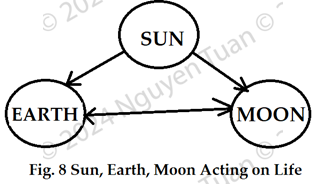
However, the exact origin of life ultimately is the God with the Word as His creative principle, that is, everything is a manifestation of the Word. Figure 4 outlines the simple chain of creation from the God through the Sun, Earth, and Moon. The 64 genetic codes emerge from this ray of creation, forming the essence of life: DNA and RNA. Figure 4 is more accurately represented by Figure 8, as the Sun influences both Earth and Moon simultaneously, without needing to pass through the Earth. In Figure 8, God’s omnipresence and activity are depicted through the interactions of the Sun, the Earth, and the Moon, which collectively generate all living beings on Earth. The life creation process is further detailed in Figures 9, 10, and 11.


Figure 9 depicts the Jewish Kabbalah Tree of Life, whose origins and meanings are complex and unclear. Figure 10 illustrates the Egyptian Paut Neteru Tree of Life; its philosophical significance has been lost, leaving only the image behind. Figure 11 presents the VanXuan Tree of Life, based on the Law of the Three and the Law of the Seven. Law of the Three—represented by the Sun, Earth, and Moon—drives all fluctuations on Earth, while Law of the Seven regulates these fluctuations. Although distinct, these two laws are unified and represent God’s fundamental creative principles. Consequently, all phenomena—whether visible or invisible—arise from this creative principle. God’s inner creative force manifests as soil, rocks, plants, animals, and humans, with all phenomena reflecting God’s ultimate reality.
In Figure 11, Law of the Three is illustrated through the three celestial bodies—Sun, Earth, and Moon—that generate all life on Earth. The process of creation adheres to the Law of the Seven, which comprises eight notes: Do, Re, Mi, Fa, Sol, La, Si, Do, ensuring harmony. Among these notes, two deviations occur between Mi-Fa and Si-Do, dividing the sequence into four sections: Do-Re-Mi; Mi-Fa, Fa-Sol-La-Si; and Si-Do. Consequently, there are four sections connecting the Do of the Sun, Earth, and Moon to the Do of Man: Do-Re-Mi; Mi-Fa, Fa-Sol-La-Si; and Si-Do.

Thus, life manifests through the creative principles of the Dao, embodied in Law of the Three and Law of the Seven, as follows:
1 – Herukhuti representing the Sun, is the source of life; without it, life on Earth cannot exist.
2 – The Moon, Lah, protects and nourishes life. Its gravity raises underground water, while tides and winds create ocean currents that distribute nutrients and detoxify Earth’s water. Without this process, marine life would stagnate and suffer. Additionally, the Moon shields Earth from asteroids and comets; its craters, formed by meteorite impacts, bear witness to its protective role.
3 – Geb, the Egyptian god of Earth, is where life germinates. The Moon’s gravity raises underground waters and cools the Earth, creating favorable conditions for plants and insects. The ancient Egyptians believed that Geb’s laughter caused earthquakes, which stimulated the growth of flora and fauna.
4 – Khonsu, representing the crescent Moon, circulates ocean and river water, maintaining a temperate climate that fosters diverse life. This cooling effect is mirrored in the Si-Do curve along the central axis. The Moon’s fluctuating light affects life on Earth, attracting nocturnal insects to plants. Dew drops on foliage help pollen adhere to these insects, promoting flower and fruit growth. Consequently, this phenomenon enhances the development of plants and insects, generating a food source for animals along the Si-Do curve.
5 – Hapy is the god of plants and trees. He is often depicted as a green fat man with sagging breasts, symbolizing fertility and abundance, often carrying plants and food.
6 – Taurt, the benevolent goddess of fertility and childbirth, is associated with the nurturing of infants. Plants, animals and humans need male and female parts to reproduce.
7 – Isis is the goddess of love, beauty, music and motherhood. The Moonlight also helps many nocturnal animals find food. The Moonlight and the cold night air stimulate people’s musical and artistic inspiration. In many mystical traditions, the Moon with its silvery light is a symbol of meditation. Buddha and many great spirits attain enlightenment on a Full Moon night.
8 – Djedhor represents the love of a father for his child. Thanks to Djedhor’s protection and nurturing, life is not interrupted. The child may not have the nourishment of the father, but the father’s seed is absolutely necessary.
9 – Thoth, the god of wild animals, emerged when food sources from plants and insects became sufficient. 10 – Ra, the god who created humans, considers them the pinnacle of creation at Do.
NEO-GNOSTIC CHRISTIANITY AND THE WORD
The Gospel of John 1:1 begins with “In the beginning was The Word,” suggesting a foundational state beyond mere time. Initially, science proposed the universe’s origin from the Big Bang but could not explain what came before. John 1:2 reveals that The “Word was both with God and was God,” signifying that before the universe existed, they were one. John 1:3-4 states, “Through The Word all things were created. Without The Word, nothing was made. Life comes through The Word.” Neo-Gnostic Christianity views The Word as the creative force behind all creation. The Second Person of the Trinity also manifests through The Word, as stated in John 1:14. The universe’s existence is thus attributed to The Word, which represents foundational spiritual laws. John 1:3-4 notes that “the light shines in darkness,” highlighting that all living beings are influenced by 48 forces (Figure. 2), preventing them from fully realizing their Divine essence.
CONCLUSION
The declaration of Creation from God (creatio ex deo) is substantiated by the holographic universe principle, establishing it as a scientific truth rather than mere dogma. This perspective aligns with various occult schools. For instance, the Tarot’s Magician card reflects the truth of “as above, so below,” with one hand pointing to God above as ultimate reality, and below as the earthly realm, symbolizing the unity of God and all things.

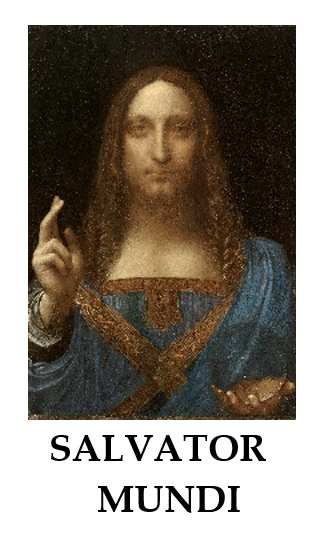
Likewise, Leonardo da Vinci’s painting Salvator Mundi emphasizes this idea; Jesus, positioned at the center, represents the singular ultimate entity. He holds an empty sphere in his left hand, indicating that the universe lacks inherent self-nature, as everything manifests from God. His right hand performs a blessing with two fingers crossed, symbolizing the unity of God and the universe.

In addition, the Tarot’s Hierophant card features a left hand holding a scepter with three horizontal bars, representing the Law of the Three, along with a vertical bar topped with seven rounded ends, symbolizing the Law of the Seven.
These laws collectively represent God’s creative principle, or The Word, indicating that God incarnates in all things, not solely in the Second Person of the Trinity. They affirm the profound truth that St. John aimed to convey—an understanding that has evolved over nearly 2,000 years – there is nothing apart from God (John 10:34), and creation is an eternal, universal, ongoing process without a definitive beginning or end.
